Aerial Yoga Benefits: What the Hammock Does for Body and Mind
By Aerial Rishikesh · Updated · 10 min read
Quick answer
The main benefits of aerial yoga come from the hammock carrying part of your weight: supported inversions that lengthen the spine without loading the neck, deeper stretching, core and grip strength from working with a moving prop, sharper balance, and a rare depth of rest in the cocoon. Research on aerial yoga itself is still small, so these benefits are best understood through how the practice works rather than through headline numbers.
Why aerial yoga feels different from mat yoga
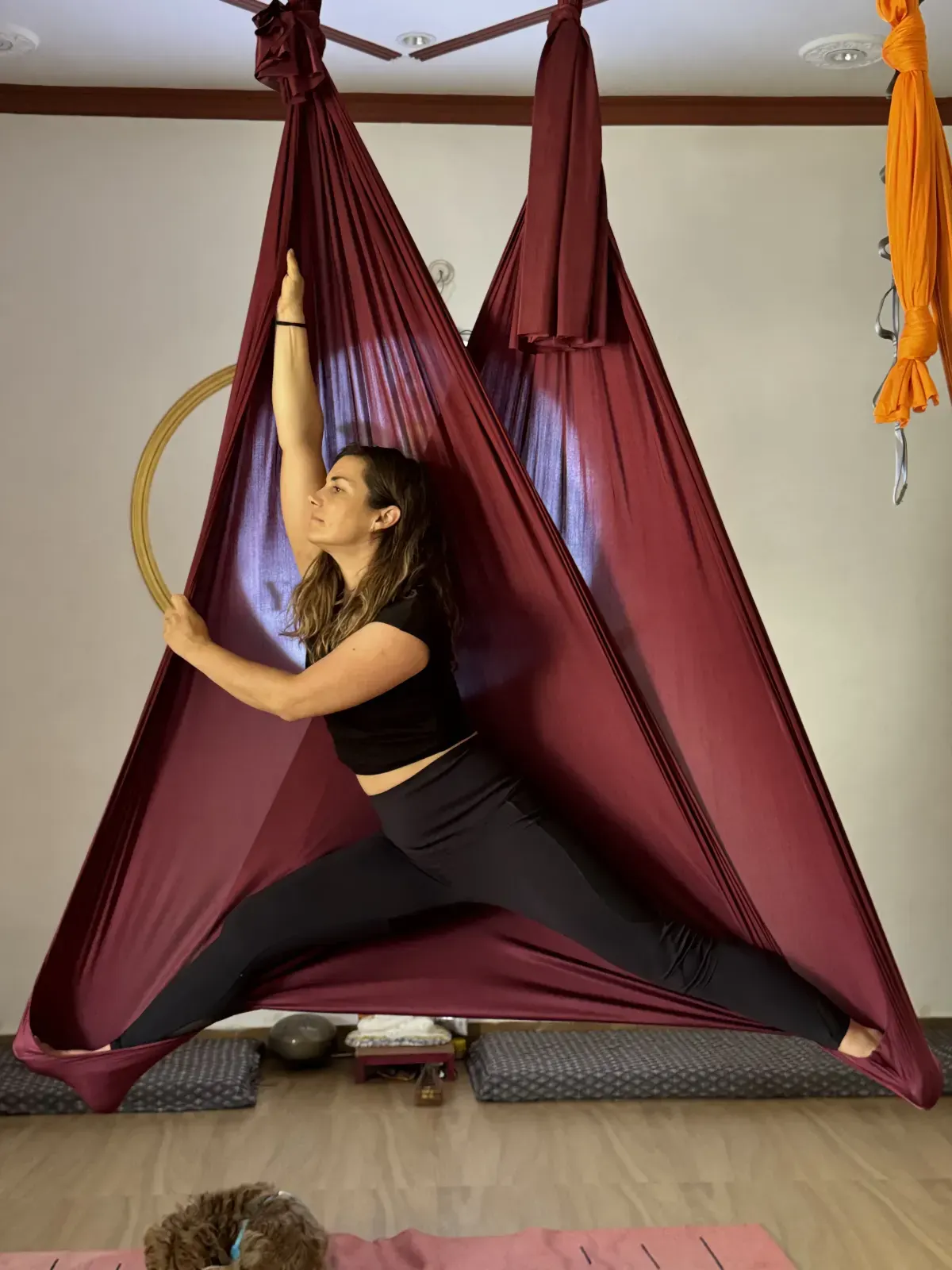
Most of the benefits of aerial yoga trace back to one simple change: a soft fabric hammock, hung from rated rigging points, takes some or all of your body weight. On a mat, gravity pushes you into the floor and every pose has to be built from the ground up. In a hammock, gravity can be used differently — to hang, to lengthen, to open — while the fabric supports you where you need it.
That support works in two directions. It makes some things easier, such as going upside down without balancing on your head, or relaxing into a stretch instead of bracing against it. And it makes other things harder, because a hammock moves, so your core, hands and balance have to keep adjusting. A good aerial class uses both. If you are new to the practice, our guide to what aerial yoga is explains the basics before you go further.
Below we have grouped the benefits into physical, mental and professional — the last for anyone thinking of teaching. Then we look honestly at what the research does and does not show, and at who should be careful.
The physical benefits of aerial yoga
Spinal decompression and gentle traction
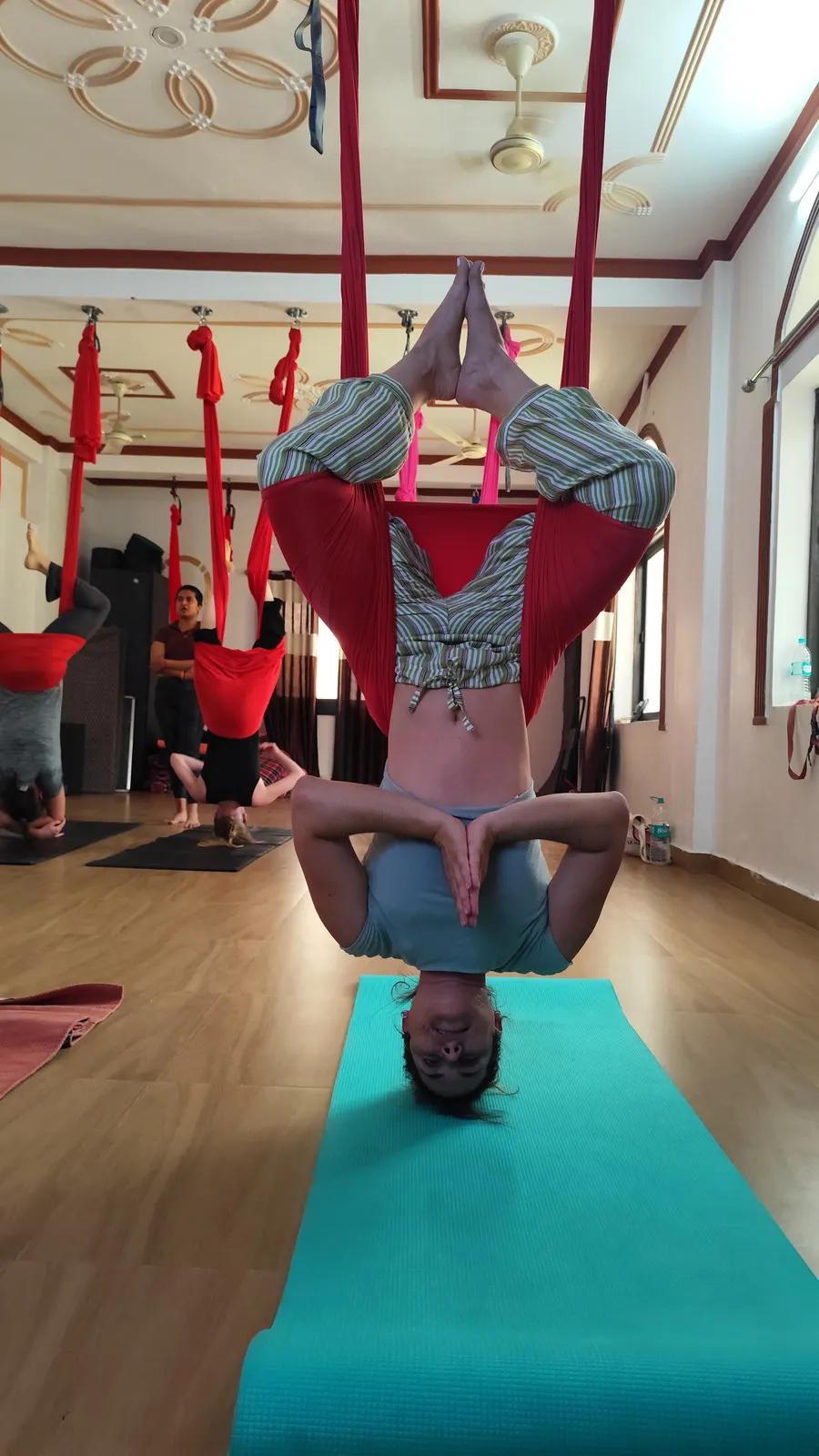
This is the benefit people ask about most, and it is the one the hammock is uniquely good at. In a supported inversion you hang from your hips or thighs, with the fabric doing the holding. Your head, arms and upper body simply hang. Instead of the spine being compressed — as it is when you stand, sit for hours or balance in a headstand — it is gently drawn long by its own weight.
Students often describe this as the feeling of “making space” between the vertebrae. We would put it more modestly: a supported hang is a comfortable way to take load off the spine for a few breaths, and many people find it relieving after long days of sitting. It is not a treatment for a spinal condition, and anyone with a back injury should speak to a doctor first.
Flexibility without forcing
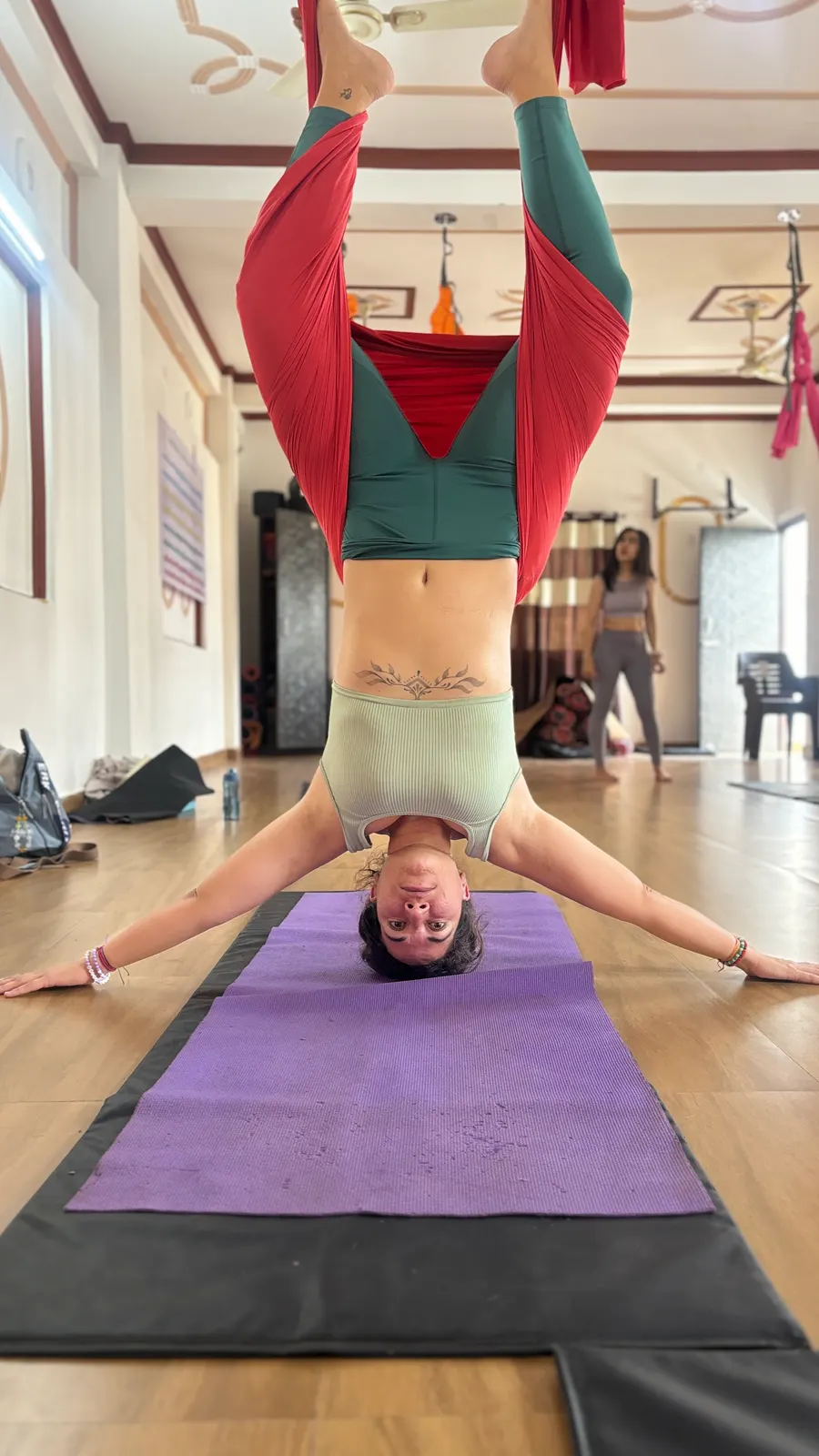
When a muscle feels unsupported, it tends to guard. When the hammock takes part of your weight — under a hip in a standing split, around a shin in flying pigeon, beneath you in a wide straddle — the body tends to let go a little more. That is why many students find they can open the hips, hamstrings and shoulders further, and more comfortably, than on the floor.
The same principle runs the other way for anyone who is already very flexible. Hypermobile students benefit from the fabric giving them something to press into, so they learn to hold a stretch with muscle rather than hanging in their joints.
Core and grip strength
A swaying hammock asks for constant small corrections. Even sitting still in the sling, the deep abdominal and back muscles work to keep you centred. Climbing into the fabric, holding a flying pose or coming out of an inversion with control adds the hands, forearms, shoulders and upper back. Grip strength is one of the first changes regular students notice — and one of the most useful in daily life.
Balance and proprioception
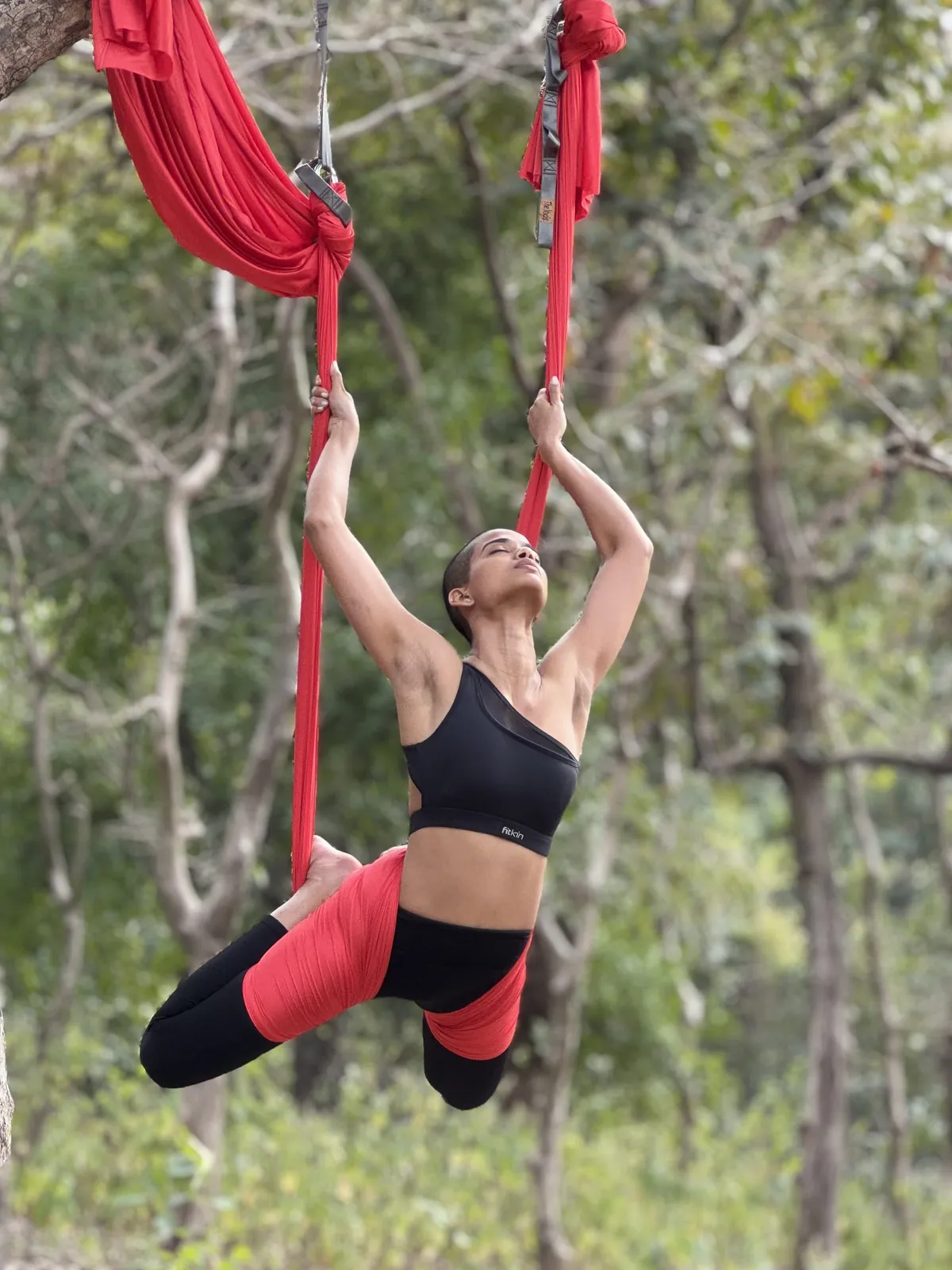
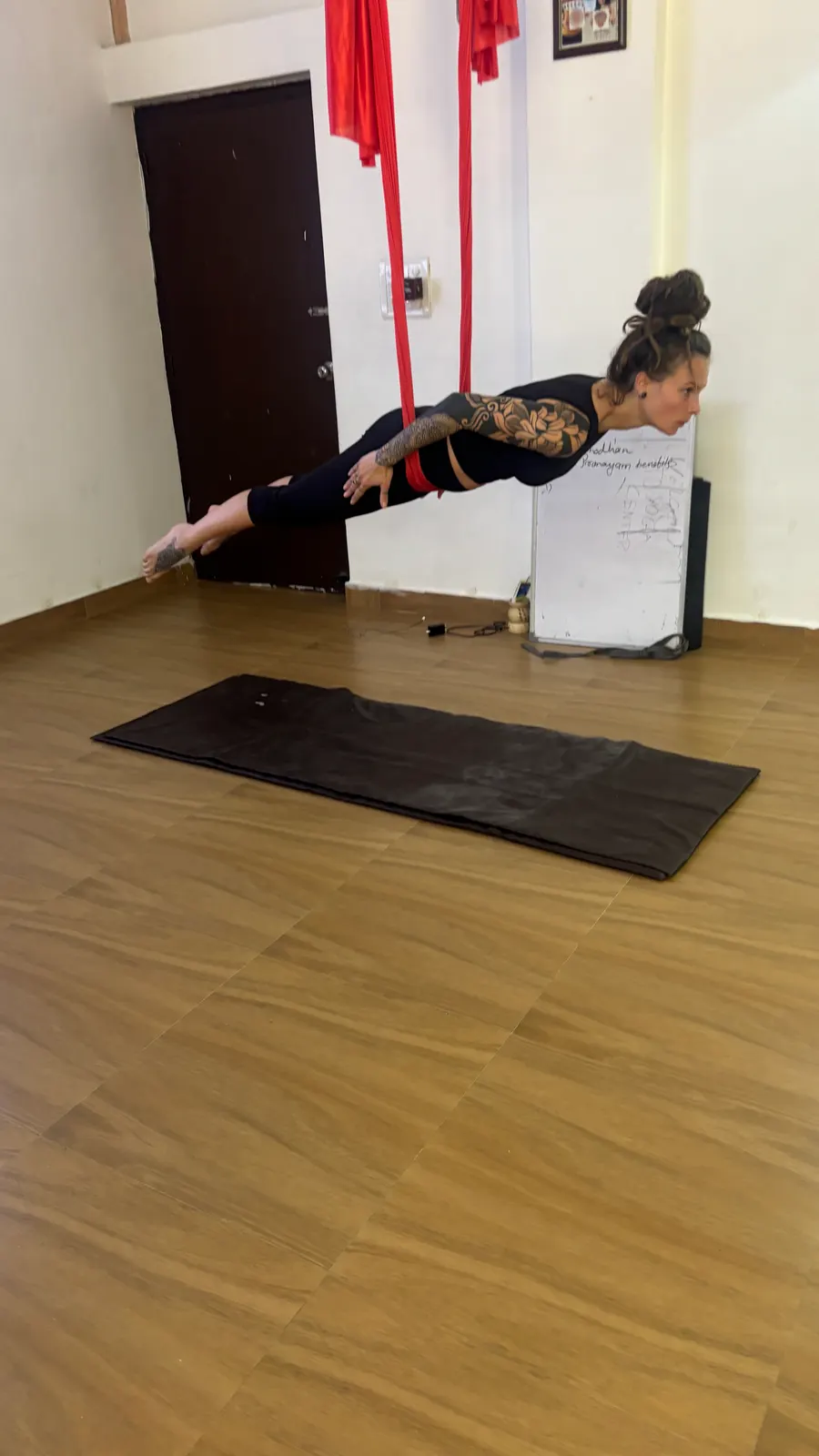
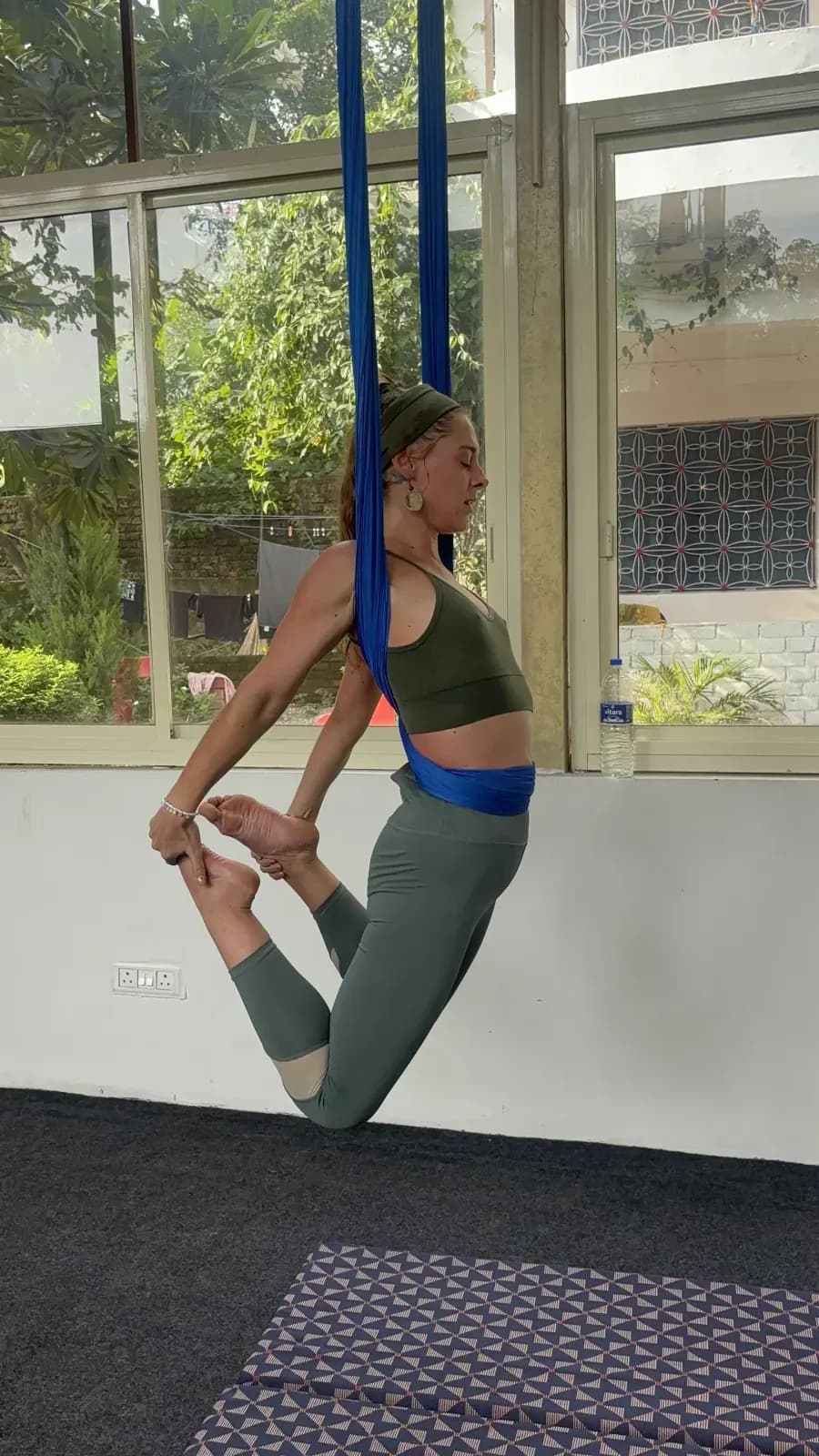
Proprioception is your sense of where your body is in space. A moving prop trains it in a way a fixed floor cannot, because the support shifts as you shift. Supported balances such as aerial dancer’s pose or a standing split with the fabric under the hip let you work at the edge of your balance with a safety net, which is a far more comfortable place to learn than the edge of a fall.
Kind to the joints
Because the fabric can carry weight that would otherwise go through the knees, wrists or lower back, many poses can be adapted for people who find kneeling or weight-bearing on the hands uncomfortable on a mat. It is low-impact by nature: there is no jumping, and transitions can be as slow as you like. That said, low-impact is not the same as no-effort, and a dynamic aerial class can be hard work.
Aerial yoga benefits at a glance
Here is how each benefit is produced by the hammock, with the poses that show it best. You can see all of them, and how to enter each one, in our guide to aerial yoga poses.
| Benefit | How the hammock creates it | Best poses |
|---|---|---|
| Spinal decompression | You hang from the hips, so the spine lengthens under its own weight with no load on the head or neck | Inverted star, inverted lotus, inverted backbend |
| Flexibility | The fabric takes part of your weight, so muscles release instead of guarding | Wide straddle, flying pigeon, standing split |
| Core strength | A moving prop needs constant stabilising, even when sitting still | Flying superman, straddle sit, assisted climb |
| Grip and upper body | Holding, climbing and controlling exits works hands, forearms and shoulders | Assisted climb, assisted handstand, tree pose with silks |
| Balance | The support shifts as you shift, training proprioception with a safety net | Dancer’s pose, split balance, tree pose with silks |
| Confidence | Supported, spotted inversions make going upside down achievable for beginners | Inverted star, supported backbend |
| Rest and stress relief | Being fully held by the fabric makes it easier to let go completely | Cocoon, floating lotus meditation |
The mental benefits of aerial yoga
Ask students what they remember from their first aerial class and they rarely mention their hamstrings. They talk about how it felt. These are the mental benefits we see most often.
- Confidence. Hanging upside down safely, often for the first time since childhood, changes how people think about what their body can do. That sense of “I did not think I could, and I did” tends to travel beyond the studio.
- Focus. It is difficult to think about your inbox while you are wrapping a hammock around your thigh. The practice demands attention to the present moment, which is much of what yoga has always asked for.
- Play. Aerial yoga is unusually playful. People laugh in class — at the swing, at a wobble, at the surprise of being upside down. Play is underrated in adult life, and the hammock gives permission for it.
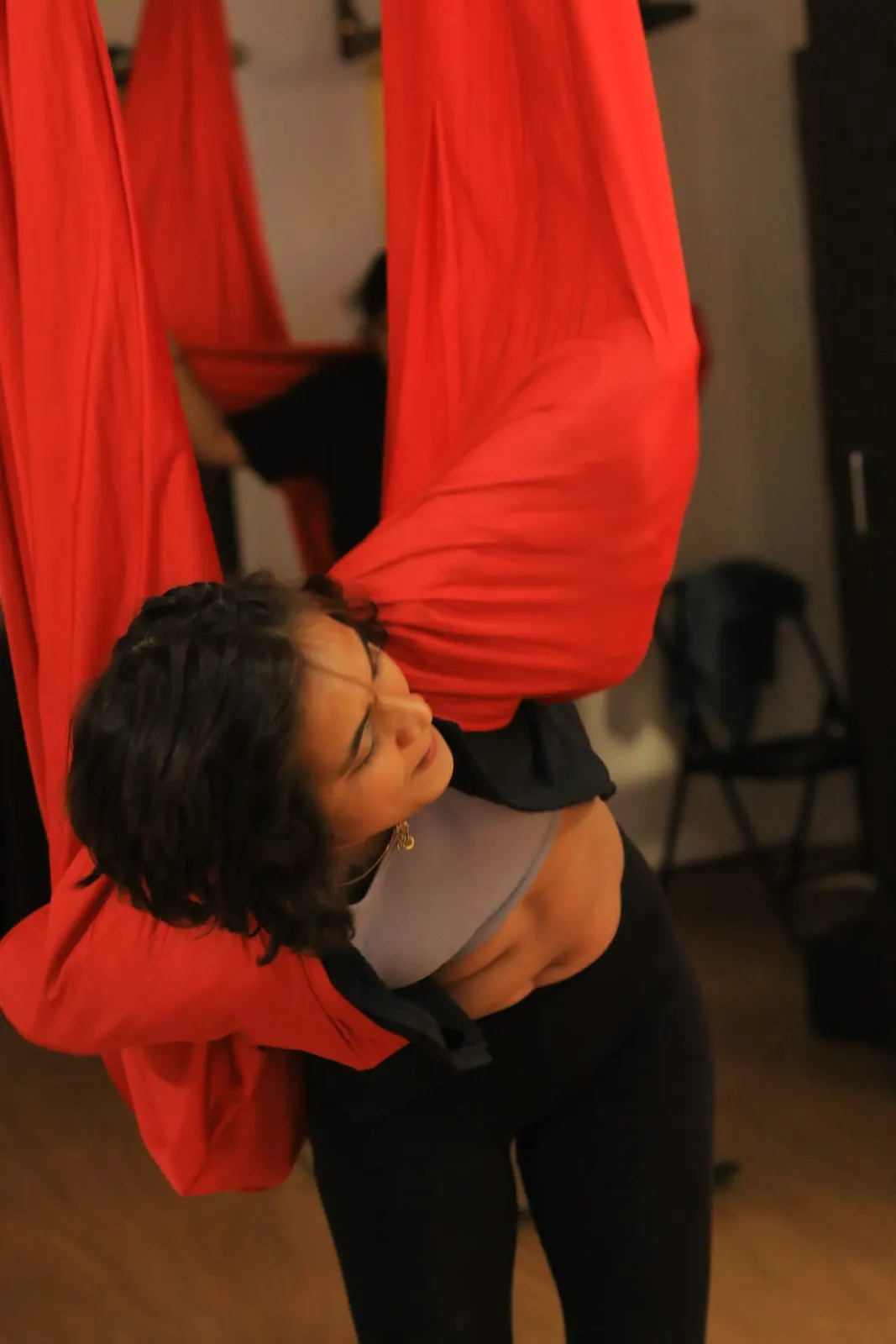
- Stress relief and rest. The class ends in the cocoon: lying fully wrapped in the fabric, gently swaying, supported on every side. Many students say it is the deepest rest they have had in any yoga class.
We would not overstate any of this. Aerial yoga is not a therapy for anxiety or depression, and anyone managing a mental-health condition should keep working with their own practitioner. But as a way to step out of a busy head for an hour, it is very effective.
Aerial yoga for back pain: a careful answer
Many people come to aerial yoga hoping it will help their back, and the gentle traction of a supported inversion is genuinely appealing if you sit for long hours. Some students with everyday stiffness tell us they feel looser and more comfortable after class. That is a reasonable thing to hope for.
But back pain has many causes, and the same hang that relieves one person can aggravate another. If you have a diagnosed disc problem, recent injury, nerve symptoms such as numbness or pain travelling down a leg, or pain that is getting worse, see a doctor or physiotherapist before you try inversions, and tell your teacher before class. A good teacher will keep you upright, use the hammock for supported stretches instead, and build up slowly. Aerial yoga can be a pleasant part of looking after your back; it is not a substitute for medical care.
What the evidence does and does not show
We want to be straightforward here, because a lot of what is written about aerial yoga benefits is not. Research on aerial yoga specifically is still small. There are only a limited number of studies, most of them with few participants and short time frames, and they are not enough to support confident claims about calories burned, measurable spinal changes or medical outcomes. You will not find statistics in this article because we do not think the evidence base yet justifies quoting them.
What we can say with confidence is narrower but still useful:
- The broader research on yoga and on regular, moderate exercise is far larger, and aerial yoga shares much of what that research describes — stretching, strengthening, balance work and deliberate relaxation.
- The mechanics are not in doubt. A supported inversion does take load off the head and neck compared with a headstand. A moving prop does demand more stabilising work than a fixed one. Supported stretching does feel more comfortable for most people.
- Much of what students report — confidence, enjoyment, a feeling of lightness — is subjective, and none the less real for it.
If you read a claim about aerial yoga that comes with a precise number, it is worth asking where the number came from.
Who should be cautious with aerial yoga
Aerial yoga is safe for most healthy adults when the rigging is professionally installed and a trained teacher is leading. Inversions are what call for care. Speak to your doctor first, and expect your teacher to modify or skip inversions, if any of these apply to you:
- Pregnancy
- Glaucoma, a detached retina or recent eye surgery
- Uncontrolled high or low blood pressure, or a heart condition
- Recent surgery, or a recent head, neck or spine injury
- Vertigo or a history of fainting
- Severe osteoporosis
None of these rules out the practice entirely, since much of a class happens seated or upright. They change what you should do in it. We cover this in more depth in our guide to aerial yoga inversions and safety.
The benefits for yoga teachers
For a yoga teacher, the benefits of aerial yoga are partly professional. Aerial is a genuinely different class to offer: it draws people who would never walk into a standard mat class, it gives regular students something new, and it lets you work with clients — older students, people who dislike weight on their wrists, the very stiff and the very flexible — in ways the mat cannot.
It also deepens your own teaching. Learning to spot, rig and cue a moving prop sharpens your eye for alignment and safety on the mat as well. If you are considering it, our guide on how to become an aerial yoga instructor walks through the path.
At Aerial Rishikesh we are one of the very few schools that teach aerial yoga exclusively. Our 50-hour aerial yoga teacher training is a seven-day foundation for teaching beginner classes, and our 100-hour aerial yoga teacher training goes further into anatomy, advanced inversions, restorative aerial and supervised teaching practice. Both are Yoga Alliance continuing-education (YACEP) certified, and both include your room and meals in Tapovan, Rishikesh.
Frequently asked questions
What are the main benefits of aerial yoga?
What are the benefits of inversions in aerial yoga?
Is aerial yoga good for back pain?
Is there scientific evidence for the benefits of aerial yoga?
Does aerial yoga help with weight loss?
How often should I practise aerial yoga to feel the benefits?
Aerial yoga teacher training in Rishikesh
Learn to teach the hammock, at a school that teaches nothing else
Seven-day and twelve-day YACEP-certified trainings in Tapovan, with your room and all meals included. Tell us when you want to come — no deposit is taken at enquiry.